


Building a Coaching Business That Lasts: AI, Strategy, and Sustainability
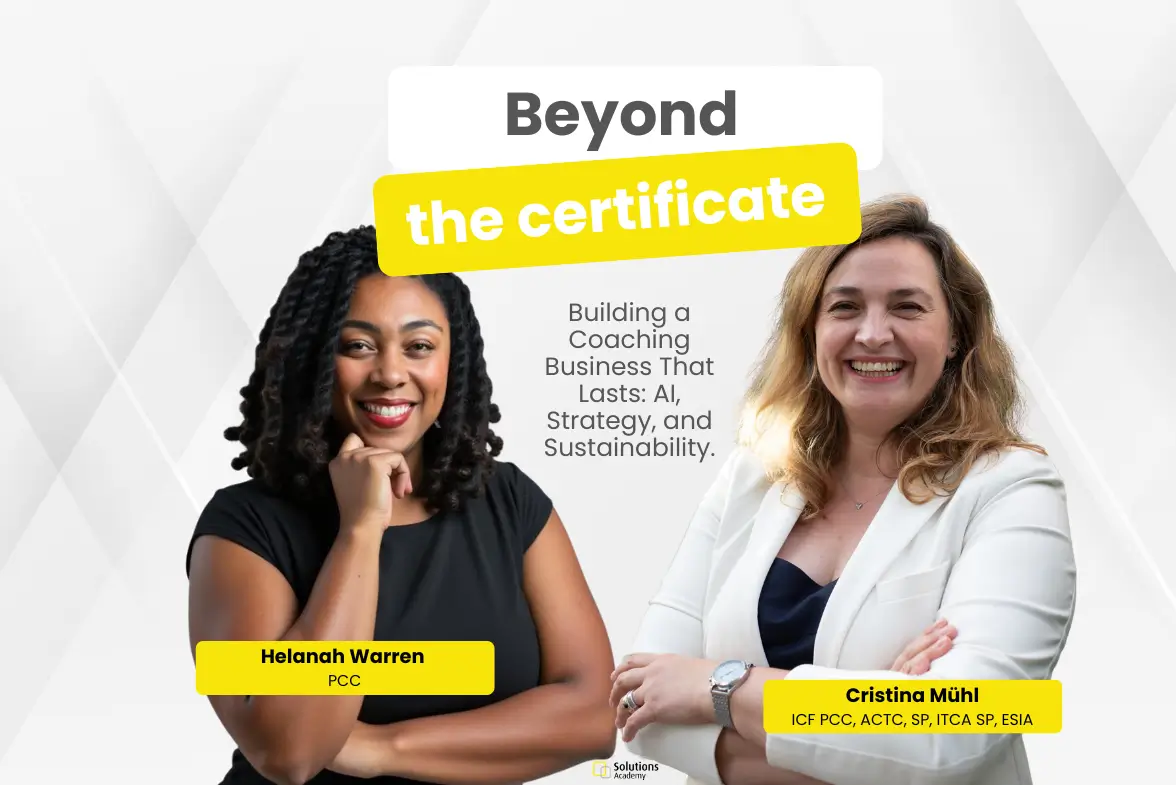
Building a Coaching Business That Lasts: AI, Strategy, and Sustainability
Getting certified as a coach is a significant milestone. It is rarely the end of the journey, and often not the hardest part.
In this conversation, Cristina Mühl from SolutionsAcademy sits down with Helanah Warren, PCC, coach, consultant, and AI integration strategist, to talk about what coaches need to think about beyond their coaching skills. What does it take to build a practice that is not just meaningful, but sustainable?
Key Takeaways
A coaching practice built without business infrastructure is fragile. One life event, one client loss, or one market shift can unravel it quickly.
The most important question is not how much can I earn, but what am I building and for whom, and is it something that can survive beyond me?
AI integration works best when it follows clarity about your business, not before it. Know your processes before you automate them.
Three practical starting points: get coaching friends, get a mentor, get a coach of your own.
Marketing foundations, digital infrastructure, and AI integration are three sequential phases, not one simultaneous leap.
Why Business Development Cannot Wait
Many coaches arrive at certification having built something almost by accident. They told their network, people responded, and suddenly there was a practice. That early momentum is real, but it often runs on relationships and energy rather than structure.
As Helanah describes it, coaches launch themselves into a service business almost overnight. The heart of it, the passion and the positive reception, drives them until it cannot anymore. A life event, a change of management at a key client, a non-renewal, and the absence of infrastructure makes everything fragile.
Cristina frames the underlying question directly: are you building a business that dies with you, one that exists only as long as you are actively coaching those two or three clients, or are you building something that will survive and thrive beyond you? Both answers are valid. But you need to know which one you are answering.
The Three Phases of Building a Sustainable Practice
Helanah works with coaches, consultants, and entrepreneurs across three phases:
Phase 1: Marketing foundations. This means knowing your ideal client profile, understanding where to find clients, and building an actual pipeline. These are basics that many coaches skip because they jumped into practice without them.
Phase 2: Digital infrastructure. Setting up automations, moving away from manual invoicing and spreadsheets, and building an email list. These systems reduce the pressure that accumulates when everything depends on the coach remembering to act.
Phase 3: AI integration. Only once you know what you are doing, how you are doing it, and why, does it make sense to bring in AI. As Helanah puts it: if someone gave you three employees tomorrow but you had no job description or process, they would be useless to you. The same applies to AI agents.
How to Think About AI as a Coach
Helanah distinguishes between two frameworks for thinking about AI in a coaching practice.
AI coaches: AI bots you can create to support your clients or your business in defined ways.
AI for coaches: using AI on the back end for marketing, administration, delivery, and business systems.
Her advice is not to be afraid of missing the AI wave entirely. She compares it to a commuter bus that keeps circling. It will come back around. The question is what will have changed by then, and what it will cost you to catch up. The more useful question is not whether to use AI, but where and for what purpose.
Three Practical Tips for Coaches at Any Stage
Get coaching friends. Solo practice can be isolating. Having peers you can call, text, and debrief with is not a luxury. It is professional sustenance.
Get a mentor. Not just a mentor coach in the ICF sense, though that matters too. A real business mentor, someone who can help you think about your practice as a practice, not just your coaching as coaching.
Get a coach yourself. Coaches who are not in coaching themselves risk losing touch with what the experience feels like from the client's side. It also ensures you are taking care of your own development rather than only managing others' growth.
Watch the Full Conversation
Exploring coaching further
This page is part of the SolutionsAcademy Info Hub. It is designed to support informed decisions, not quick ones.
If you are curious to go deeper, you may find these next steps useful:
- See when coaches typically see a return on their training investment → ROI After Coach Training
- Get an honest picture of how long it takes to get coaching clients → How Long It Takes to Get Coaching Clients
- Understand what career paths open up after certification → Career Paths After Coaching Certification
- Experience coaching questions in practice → Join the next free meetup

Cristina Mühl
FAQ
Do I need to think about business development while I am still in training?

- Yes, and ideally before you finish. Many coaches build an early practice on personal relationships and momentum, without any underlying structure. When that momentum slows, the absence of marketing foundations, client pipeline, and systems becomes visible and costly to fix under pressure.
How do I know if my coaching practice has enough infrastructure?
- A useful test is whether your business could survive a significant personal disruption, a family event, an illness, a key client leaving. If the answer is no, the infrastructure is not there yet. Basic markers include a documented client pipeline, automated invoicing and scheduling, a clear client onboarding process, and some form of ongoing visibility beyond referrals.
Is AI necessary for coaches to build a sustainable practice?
- Not immediately, and not without context. AI is most useful once you have clarity about your business model, client profile, and processes. Bringing in AI before those foundations are in place tends to add complexity rather than reduce it. Once the foundations are solid, AI can genuinely reduce administrative load and support client delivery in meaningful ways.
What is the difference between a mentor coach and a business mentor for coaches?
- A mentor coach, in the ICF sense, provides feedback on your actual coaching practice, reviewing sessions and supporting your development against professional competency standards. A business mentor focuses on the commercial and strategic side of your practice: positioning, pricing, marketing, and growth. Both are valuable and serve different functions. Many coaches need both at different stages.
How long does it typically take to build a stable coaching business?
- Most coaches who treat their practice as a business from the start, investing in visibility, infrastructure, and ongoing development, reach a stable footing within two to four years. Those who wait until momentum naturally runs out before addressing business fundamentals often find that process takes longer and is more disruptive. Starting early, even with small steps, consistently produces better outcomes.


