


June 16, 2026
What Is Coaching?

What Is Coaching?
Coaching is often mentioned alongside mentoring, counseling, or consulting. That is where confusion usually starts.
At its core, coaching is a professional partnership that supports people in thinking more clearly, making conscious choices, and taking responsibility for their own development. A coach does not give advice or tell clients what to do. Instead, coaching creates space for reflection, learning, and forward movement.
What is professional coaching designed to do?
Coaching supports people who want to move forward in a thoughtful and self-directed way.
It is commonly used to:
- Clarify goals and priorities
- Improve decision-making
- Strengthen self-leadership
- Navigate change or complexity
- Reflect on patterns, habits, and assumptions
Coaching works with the present and the future. It assumes that the client is capable of finding their own answers, with the right questions and support.
What coaching is not
Coaching is often confused with other helping professions. While there can be overlap, the roles are not the same.
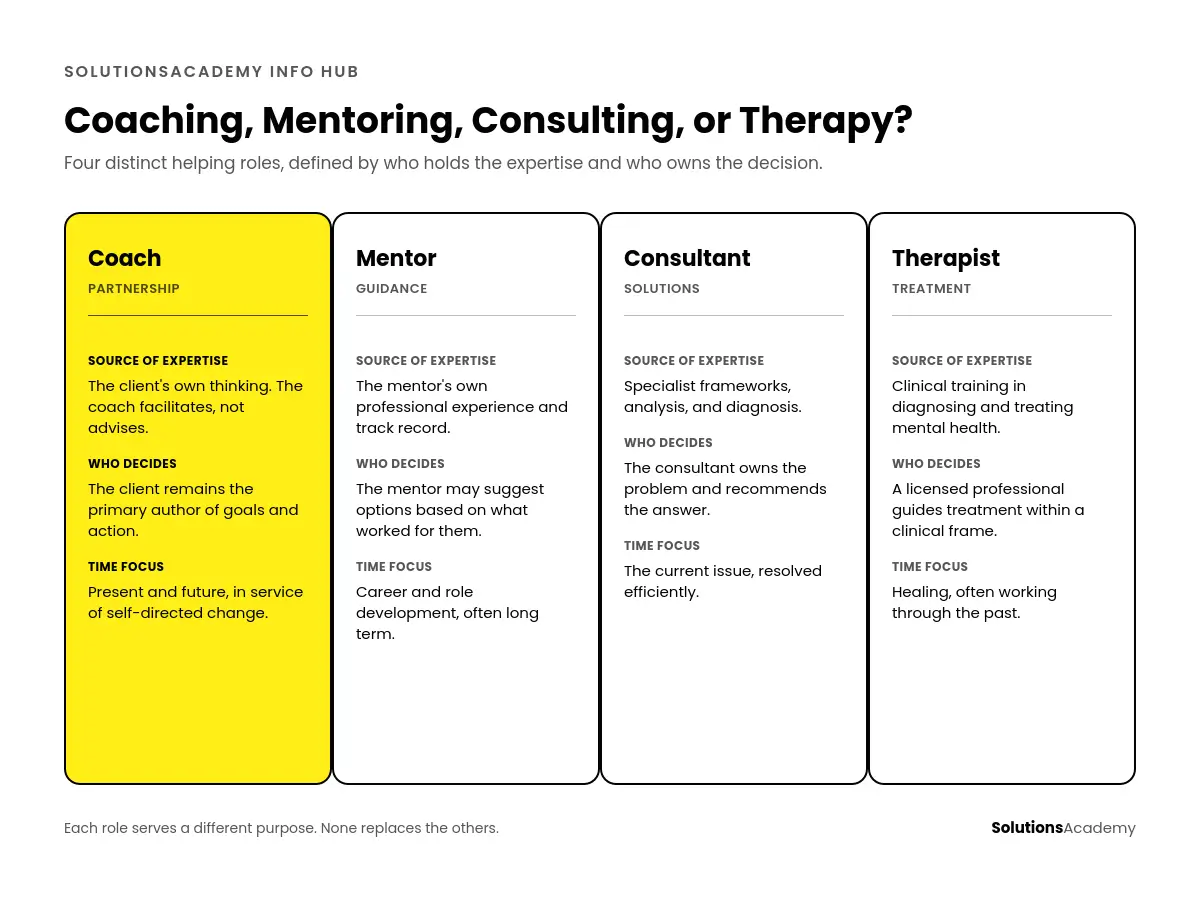
- Coaching is not mentoring. A mentor shares experience and guidance from their own professional journey.
- Coaching is not counseling or therapy. Therapy focuses on healing, mental health, and working through the past.
- Coaching is not consulting. Consultants analyze problems and recommend solutions.
Where is professional coaching commonly used?
Coaching appears in many contexts, including:
- Leadership and executive development
- Team development and collaboration
- Career and role transitions
- Organizational change
- Personal development and self-leadership
Each context has its own focus, but the underlying coaching approach remains the same: supporting awareness, responsibility, and learning.
Is coaching the right approach?
Coaching is most helpful when someone:
- Wants to think things through rather than receive advice
- Is open to reflection and learning
- Is ready to take responsibility for their own actions
A closer look at the coaching stance
Coaching did not emerge in a vacuum. It grew at the intersections of training and adult learning, organizational development, counseling, psychotherapy, and other fields. As a result, it carries family resemblances to neighboring practices. This is both its strength and the source of much confusion. Coaching is better understood as a particular way of being in conversation, shaped by specific assumptions about agency, expertise, and change.
Most professional coaching bodies define coaching as a partnership. The International Coaching Federation, for example, speaks of partnering with clients in a thought-provoking and creative process that supports them in making the most of their personal and professional potential. This wording is not accidental. It signals a move away from expert-driven helping relationships and toward a co-created process in which the client remains the primary author of meaning, goals, and decisions.
In coaching, the coach does not diagnose, prescribe, or correct. The coach also does not decide what a good life, a healthy organization, or a successful career should look like for the client. Instead, the coach takes responsibility for the quality of the conversation and for holding a reflective, ethically grounded space in which the client can think, notice, experiment, and decide.
What is the difference between coaching and mentoring in depth?
Mentoring is often the closest cousin to coaching, particularly in professional and organizational contexts. Both involve developmental conversations, both can be future-oriented, and both can feel supportive and encouraging. The key difference lies in the source of expertise.
In mentoring, the mentor's experience is explicitly part of the offer. Mentors draw on their own professional trajectories, mistakes, insights, and success stories, and may suggest options based on what worked for them.
In coaching, the coach's experience of the client's domain is secondary. What matters more is the coach's capacity to facilitate thinking. A coach might have worked in leadership for decades or might never have managed a team. Either can be competent, provided the coach does not replace the client's sense-making with their own.
This does not mean coaching is empty of content. Coaches inevitably bring their worldviews, values, and assumptions into the room. The ethical task is not to pretend otherwise, but to remain transparent, reflexive, and responsive. When coaches slip into mentoring without noticing, they quietly shift authorship away from the client.
What is the difference between coaching and consulting?
Consulting differs from coaching primarily in terms of problem ownership and solution responsibility. Consultants are hired to analyze situations, diagnose issues, and recommend or implement solutions. Their value lies in their expertise, frameworks, and ability to deliver answers efficiently.
In coaching, the coach does not own the issue and does not deliver solutions. Even when a coach has strong opinions about what might help, these opinions are treated as hypotheses at best, not instructions. The client remains responsible for defining what the problem is, what matters, and what action makes sense in their context.
This difference can be uncomfortable for organizations accustomed to buying certainty. Coaching can look inefficient when measured by how quickly advice is given. Its effectiveness lies elsewhere: in supporting clients to develop their own judgment, resilience, and capacity to navigate complexity beyond the immediate issue.
What is the difference between coaching and therapy?
The comparison between coaching and therapy tends to generate the most heat, partly due to regulatory frameworks and partly due to lingering cultural assumptions about mental health and development.
Therapy, broadly speaking, is concerned with alleviating psychological suffering and supporting mental health. Therapists are trained to work with diagnosable conditions, trauma, and patterns of distress that significantly impair a person's ability to function or experience well-being.
Coaching does not aim to treat mental illness. Coaches do not diagnose, and they do not offer treatment. This does not mean coaching conversations are always cheerful or superficial. Clients bring grief, anxiety, self-doubt, and exhaustion into coaching all the time, because these are part of being human. The difference lies in how these experiences are held and what the coach takes responsibility for.
In coaching, the client is approached as fundamentally capable, even when they feel stuck or overwhelmed. When a coach notices that a client's needs exceed the scope of coaching, ethical practice requires a referral to therapy or another form of support.
Problems arise when the distinction is reduced to slogans such as "coaching is for the future and therapy is for the past." Human lives do not unfold that neatly. Both coaching and therapy may involve past experiences, present patterns, and future hopes. What differs is the frame, the mandate, and the depth at which certain issues are addressed.
Why do the distinctions between helping roles matter?
There is a temptation to defend coaching by drawing ever sharper boundaries, as if clarity required walls. In practice, this often leads to oversimplification. Real conversations are messy, and clients do not arrive with labels neatly attached.
Ethical coaching is less about policing borders and more about ongoing discernment. Coaches need to notice when they are being pulled into roles they have not contracted for, when their own preferences start to dominate the conversation, or when a client's needs call for a different kind of support. This discernment is cultivated through supervision, reflective practice, and a willingness to remain a learner.
Power is always present in helping relationships, whether acknowledged or not. When roles are blurred without reflection, clients may defer to the coach's authority in ways that limit their agency, or they may receive support that is insufficient or inappropriate for their situation. Clear distinctions protect diversity in helping practices. Coaching does not need to become a watered-down version of therapy, nor does it need to mimic consulting to appear legitimate.
Professional coaching and standards
A professional coach is accountable, not only to the client but also to ethical standards and to their own professional community. Confidentiality, informed consent, and clarity about scope allow coaching to be both supportive and safe.
Exploring coaching further
This page is part of the SolutionsAcademy Info Hub. It is designed to support informed decisions, not quick ones.
If you are curious to go deeper, you may find these next steps useful:
4. Experience coaching questions in practice → Join our next free meetup.

Kirsten Dierolf
FAQ
Is coaching the same as therapy?

- No. Therapy is concerned with alleviating psychological suffering and treating diagnosable conditions, typically through a licensed mental health professional. Coaching does not diagnose or treat mental illness. It works with the client's capacity to think clearly and act intentionally, and refers out when a client's needs exceed that scope.
What is the main difference between coaching and mentoring?
- The source of expertise. A mentor draws on their own professional experience and may suggest options based on what worked for them. A coach's experience of the client's domain is secondary. The coach's role is to facilitate the client's own thinking, not to share a personal track record.
Why doesn't a coach just give advice if they have a good idea?
- Because coaching is built on the client remaining the primary author of their own decisions. A coach may hold a strong opinion, but it is treated as a hypothesis to explore with the client, not an instruction to follow.
Do I need a certification to call myself a coach?
- Legally, coaching is largely unregulated, so anyone can use the title. Credentials from bodies like the ICF or EMCC signal that a coach has met defined training, ethics, and competency standards.
Can coaching be done online?
- Yes. Online coaching is widely used and considered as effective as in-person coaching for most contexts, since the core mechanism is the conversation itself rather than physical presence.


