


May 29, 2026
The Cost of Coaching Certification: What You Really Pay For in 2026

The Cost of Coaching Certification: What You Really Pay For in 2026
Key Takeaways
ACC-level training typically costs €2,000–€6,000 in tuition, while PCC pathways range from €5,000–€12,000, and MCC development can add €8,000–€20,000 over several years of advanced learning.
The total cost of coaching certification is significantly impacted by the fee structure you choose and the level of experience your trainers bring.
Total investment goes beyond tuition. Budget for mentor coaching, ICF membership and application fees, exams, learning materials, potential travel, and renewal costs every three years.
Quality ICF- or EMCC-accredited training usually pays back within 1–3 years for coaches who actively build a practice or apply coaching skills internally within their organization.
SolutionsAcademy's Coaching Fundamentals at €2,800 (including mentoring) serves as one concrete benchmark, but many other reputable schools exist across Germany and Europe.
ICF does not sell training. Their role is to help you understand the market, standards, and how to evaluate programs objectively.
Why does understanding the cost of coaching certification matter?
This article focuses on the cost of becoming a professionally trained, certified coach, not on what coaches charge their clients. If you are researching whether to pursue coaching certification, understanding the full investment upfront will help you plan realistically and avoid surprises.
In 2026, interest in coaching across Germany and Europe continues to grow. More online programs are available than ever before, and price ranges are wider than they were a decade ago. Whether you are considering a career change, looking to add coaching skills to your leadership toolkit, or exploring internal coaching roles within your organization, the financial commitment deserves careful attention.
This article is written as part of the SolutionsAcademy Info Hub. The goal is to offer neutral, transparent guidance so you can make informed decisions.
Here is what you will learn:
- Typical price ranges for ACC, PCC, and MCC pathways
- A full breakdown of costs beyond tuition
- Realistic ROI timelines and break-even calculations
- How to evaluate programs and recognize red flags
Throughout this guide, examples refer mainly to ICF pathways (ACC, PCC, MCC) and occasionally to EMCC, since many German and European schools hold both accreditations.
What key factors drive the total cost of coach training and certification?
Prices for coaching programs vary widely. Training providers often tailor their programs to a specific target market, such as aspiring life coaches, business coaches, or internal corporate coaches. Understanding what drives these differences helps you compare options more effectively.
Accreditation and Quality Standards
The difference between ICF-accredited programs (Level 1, Level 2, Level 3) and unaccredited short courses is significant. Programs with ICF or EMCC accreditation typically cost more because they must meet strict requirements. Faculty must hold recognized credentials such as PCC or MCC. Curriculum must cover defined competencies in sufficient depth. Assessment processes must demonstrate trainee competence.
Unaccredited courses may offer introductory coaching skills at lower prices, but they do not prepare you for an internationally recognized credential.
Training Hours and Depth of Curriculum
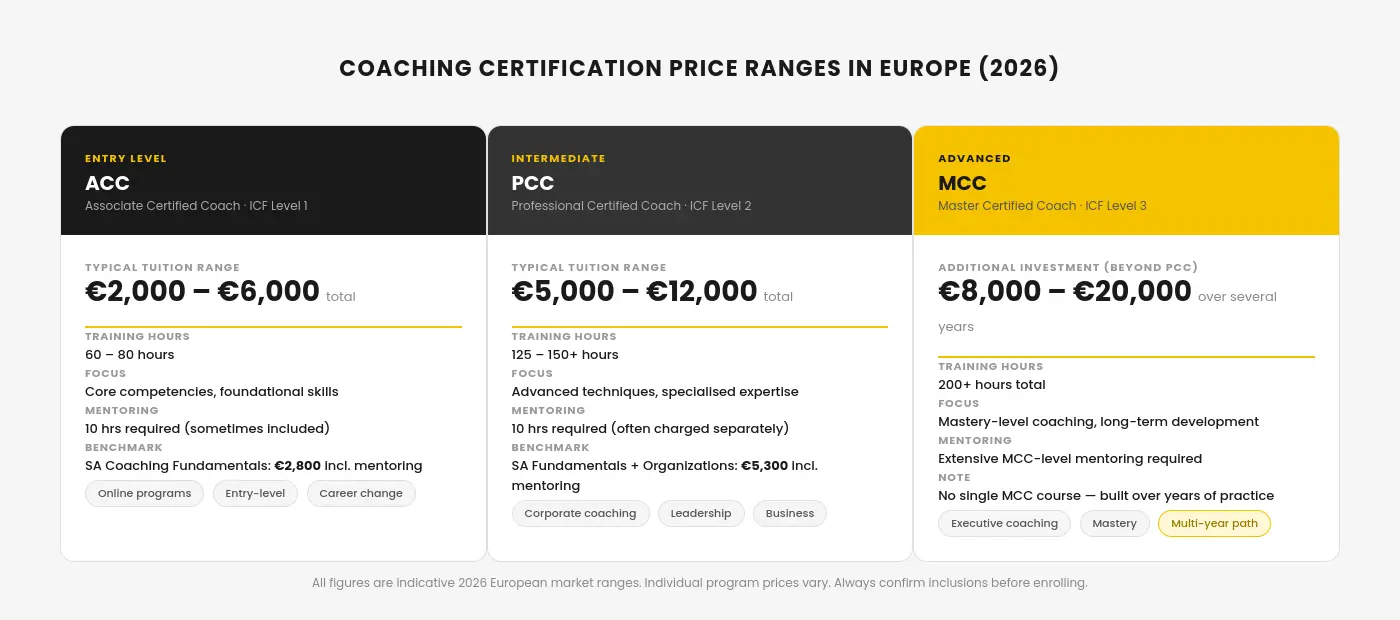
More hours and practice mean higher prices, but also more profound learning. ACC-level programs require a minimum of 60 hours and focus on core competencies and foundational skills. PCC-level programs require 125–150 hours or more and cover advanced techniques and specialized expertise. MCC-level development requires 200 or more total hours and focuses on mastery-level coaching over the long term.
Programs with observed coaching sessions, structured feedback, and extensive practice labs cost more than lecture-style courses but deliver more value for serious practitioners.
Delivery Format and Location
Fully online live training is often more affordable and flexible, eliminating venue and travel costs. Blended or in-person modules carry higher prices due to venue rental and smaller group sizes. Weekend intensives in Berlin, Frankfurt, or Munich can add €500–€2,000 in travel and accommodation per module.
Faculty and Mentoring Experience
Programs led by experienced PCC and MCC coaches, with individual mentoring and detailed feedback, command premium pricing. A coach's experience directly influences the quality of your training. Many coaches find that personalized mentoring accelerates their development far more than group sessions alone.
Support Structure and Extras
Beyond core training, consider what else is included: peer practice groups and supervision, career support and business-building guidance, alumni networks and ongoing community access, and resources for continuing education. These elements can justify higher fees, especially for those pursuing coaching as a long-term career.
What are the typical price ranges for ACC, PCC, and MCC coaching pathways?
All figures below are indicative 2026 European market ranges, based on publicly available prices from multiple providers. Prices can vary depending on program content, delivery format, and whether the focus is on business coaching, life coaching, or another niche.
ACC-Level Training
For ICF Level 1 or ACC pathways, expect total tuition costs of approximately €2,000–€6,000 in Europe, covering 60–80 training hours. The lower end (€2,000–€3,000) typically covers group-only online programs with less individual mentoring. The higher end (€4,000–€6,000) includes in-person modules, extensive practice labs, and more personalized feedback.
As a concrete benchmark, SolutionsAcademy's Coaching Fundamentals program (ICF Level 1 / ACC track) costs around €2,800 in 2026 and already includes the required mentoring hours. Use this to compare what other providers include versus what they charge separately.
PCC-Level Training
For ICF Level 2 or PCC pathways, realistic prices range from €5,000–€12,000 for 125–150 or more training hours. Prices can be higher for modular in-person programs with intensive engagements, programs integrated into university degrees, and comprehensive programs with leadership development components.
MCC-Level Development
There are fewer dedicated MCC programs because mastery-level development happens over years of experience, not a single course. Serious MCC preparation, beyond prior PCC training, can add €8,000–€20,000 over several years when you include advanced courses, extensive mentoring with MCC-level coaches, and ongoing supervision and peer learning.
Bridge or Upgrade Programs
Coaches who trained elsewhere sometimes purchase bridge programs to align with ICF standards. These typically cost €1,500–€4,000 depending on missing hours and mentoring requirements.
What hidden expenses are included in a full coach certification cost breakdown?
Beyond tuition, various additional costs contribute to your total investment.
Tuition Fees
Core tuition for an ICF-accredited program represents roughly 60–75% of your total investment. ACC tuition typically ranges from €2,000 to €6,000. PCC tuition ranges from €5,000 to €12,000. MCC advanced modules are variable, often €3,000–€8,000 per course.
Mentoring and Supervision
ICF requires at least 10 hours of mentor coaching for ACC and PCC credentials. Some schools include this in tuition; others charge separately. External mentor coaching rates in Europe typically range from €100 to €300 per hour with experienced PCC or MCC mentors. If not included in your program, budget €1,000–€3,000 for mentoring alone.
ICF Membership and Application Fees
As of June 2026, ICF Global membership costs $270 USD per year. If you select Germany as your local chapter, this automatically includes ICF Germany membership at an additional €150 per year. Application fees vary by credential level and by whether you are already a member at the time of applying, since non-member rates are typically higher. Because these figures are updated periodically, always confirm exact current application fees directly on the ICF Global website (coachingfederation.org) and, for the Germany-specific portion, via ICF Germany (coachingfederation.de) before finalizing your budget. ACC applications are at around US$300, PCC applications at US$300–$500 depending on the pathway, and MCC applications at US$575–$775.
Learning Materials and Tools
Typical extra costs include books and manuals (€100–€300), online platform access fees, and optional psychometric tools such as DISC, Hogan, or MBTI (€500–€2,500 for separate certification).
Travel, Accommodation, and Time Off Work
In-person intensives can add substantial cost. Budget €500–€2,000 for travel-related expenses if your program includes in-person components, including 2–3 hotel nights per module at €100–€200 per night in major cities.
Renewal and Continuing Education
ICF credentials require renewal every three years. Ballpark renewal costs range from €300 to €1,500 per three-year cycle, depending on whether you choose short online CCEs or more extensive advanced courses.
What payment models and funding options are available for coach training?
Most reputable programs offer flexible payment options to help trainees balance jobs, families, and career transitions.
Upfront Payment
Many schools offer a 5–10% discount for paying the full tuition before the program starts. This suits people with savings or employer sponsorship who want to minimize total cost.
Installment Plans
Monthly or quarterly installments over 6–18 months are common for ACC and PCC-level programs. When evaluating installment options, look for transparency on the total cost, including any surcharge, late-payment rules, and what happens if you need to pause or withdraw.
Employer Sponsorship and Corporate Budgets
HR departments in Germany and Europe increasingly fund coach training for internal HR professionals, L&D specialists, and senior leaders. Typical contributions can cover 50–100% of tuition. If you are employed, consider preparing a brief internal business case outlining the benefits: building an internal coaching pool, improving leadership development, reducing external coaching spend, and supporting talent retention.
Public Funding and Tax Aspects (Germany)
Some German states occasionally offer training subsidies for recognized professional development programs. Coaching training may also be tax-deductible as professional education for self-employed coaches or employees developing job-relevant skills. Consult a tax advisor for guidance specific to your situation.
Is a coaching certification worth it? ROI and break-even calculations
Different ROI Paths
Return on investment varies depending on how you plan to use your coaching skills. External coaches who sell coaching services to clients can calculate direct financial returns through coaching fees. Internal coaches and leaders who use coaching skills within their organization realize value through improved team performance, better decision-making, and enhanced leadership effectiveness.
Simple Break-Even Example for ACC-Level Coaches
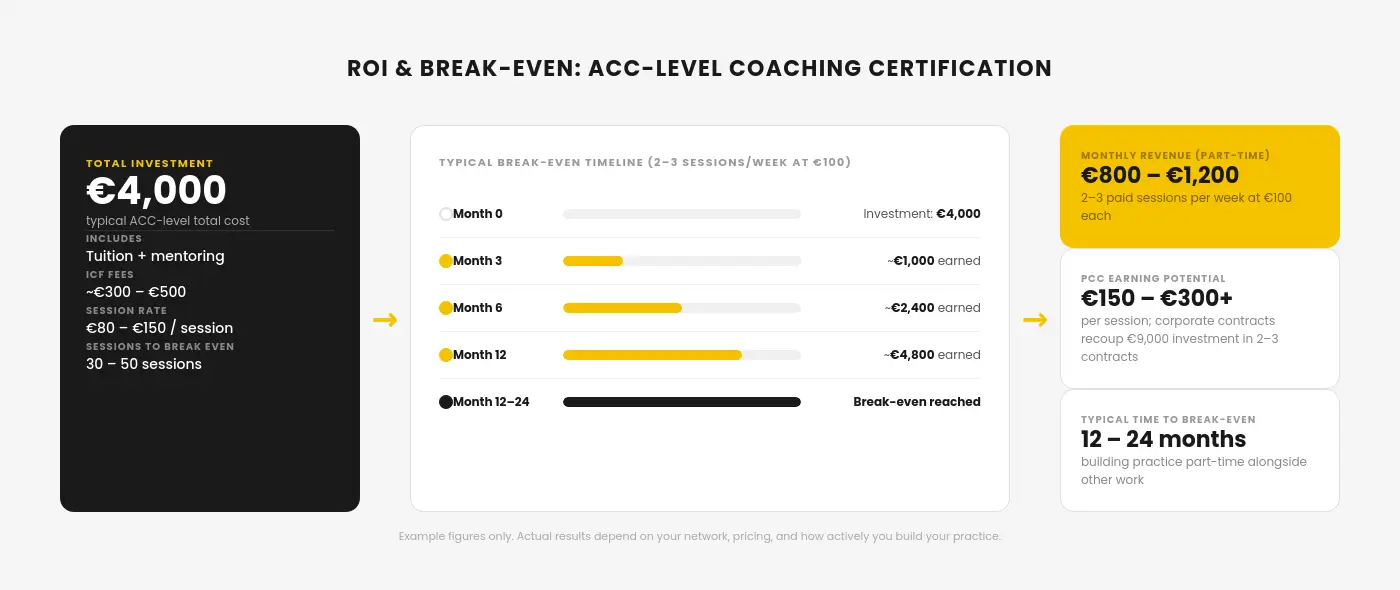
Consider a total investment of €4,000 and a starting rate of €80–€150 per session. You need roughly 30–50 sessions to break even. At 2–3 paid coaching sessions per week at €100 each, you generate roughly €800–€1,200 in monthly revenue from coaching. At this pace, many new coaches reach break-even within 12–24 months while building their practice part-time.
PCC-Level Earning Potential
Experienced PCC coaches often command €150–€300 or more per session for individual coaching, as well as corporate-level coaching packages for executive and leadership clients. A €9,000 PCC pathway investment could be recouped through just two or three well-structured corporate coaching contracts with senior leaders.
ROI for Internal Coaches and Leaders
For those applying coaching skills within an organization, benefits include improved team engagement and collaboration, reduced turnover and hiring costs, better cross-functional communication, and faster development of high-potential employees.
When Not to Invest Yet
If you cannot commit time for practice, mentoring, and client work in the next 12–18 months, consider starting with a short introduction course, free ICF resources and events, or peer practice groups to explore whether coaching suits you. Rushing into a full certification pathway without time to apply what you learn regularly leads to frustration and wasted money.
How do you evaluate coach training programs and avoid industry red flags?
Check Accreditation and Faculty
Confirm whether the program is accredited by ICF (Level 1, Level 2, Level 3) or EMCC. Verify that trainers and mentors hold recognized credentials. You can check the ICF Education Search and the EMCC website for accredited programs.
Transparency of Curriculum and Assessment
Look for programs that publish clear syllabi with learning objectives, the number of live training hours versus self-study, how competence is assessed, and the structure for practice coaching and feedback.
Warning: some programs promise “ICF certification” without clarifying whether they are actually ICF-accredited or merely prepare you to apply independently.
Realistic Promises About Income and Speed
Be cautious about claims like “Become a 6-figure coach in 90 days" or "ICF credential guaranteed.” Building a successful coaching practice takes time, effort, and often years of consistent work. Choose providers that speak honestly about what is required.
Support Beyond the Classroom
Quality programs offer peer practice groups, observed sessions with structured feedback, access to supervision, and communities of practice. These matter as much as the training hours themselves.
Contract Terms and Hidden Costs
Before enrolling, check carefully what is included in the advertised price. Mentor coaching hours are typically charged separately at €1,000–€3,000 extra if not included. Resit fees vary and can run €100–€500. Supervision is rarely included and typically costs €50–€150 per hour.
Red flags include aggressive sales tactics, pressure discounts with urgent messaging, unclear refund policies, or reluctance to provide written terms.

Exploring coaching further
This page is part of the SolutionsAcademy Info Hub. It is designed to support informed decisions, not quick ones.
If you are curious to go deeper, you may find these next steps useful:
- Understand what coaching actually involves before you commit → What Is Coaching?
- See what a coaching credential is actually worth → What Can You Do With a Coaching Certification?
- Compare live, online, and hybrid training formats → Live, Online, or Hybrid Coaching Training
- Experience coaching questions in practice → Join our next free meetup.
FAQ
How much should I budget in total for an ACC-level ICF credential?

- For a typical path in 2026, many people invest around €3,000–€6,000 total, including tuition, mentoring (if not included), ICF fees, books, and smaller extras. If your program includes in-person modules, add several hundred euros more for travel and accommodation. Start by confirming what your chosen program includes, then budget separately for ICF membership and application fees.
Can I start with a cheaper, non-accredited course and later move to ICF?
- This is possible, but it may end up more expensive overall. Non-accredited hours do not always count toward ICF requirements, so you might need to repeat learning you have already paid for. Before choosing a non-accredited course, confirm in advance how many hours can be recognised toward ICF credentials. Going directly into an ICF- or EMCC-accredited program often proves more cost-effective in the long term.
Do I really need an ICF or EMCC credential to work as a coach?
- Coaching is not legally regulated in Germany, so a credential is not mandatory. However, many organisations now request ICF or EMCC credentials when hiring external coaches or developing internal coaching programs. Credentials signal adherence to ethical standards and professional competencies that give clients confidence in your services.
Is it cheaper to study in English rather than German?
- English-language online programs sometimes cost slightly less due to larger international cohorts. However, price differences are often modest. If you plan to coach primarily German-speaking clients, training in German may better prepare you for real-world coaching engagement. The desired outcome should guide your decision more than marginal cost savings.
What if I cannot afford a full program right now?
- You have options while saving for a full accredited program: attend shorter coaching skills workshops (often €200–€800), participate in free ICF Germany events and webinars, join peer practice groups, or ask providers about scholarships or extended installment plans. Avoid extremely low-cost, unstructured training that promises quick results. Building genuine coaching competence takes time and proper training.


